
Stablecoins in KSA: What a Riyal-Backed Token Could Look Like
In short: a riyal-backed stablecoin would be a digital token pegged 1:1 to the Saudi riyal, fully backed by reserves, and transferable on a blockchain in seconds. This post breaks down how it would work, who would issue it, the economics behind it, and which blockchain could realistically run it in KSA.
As I was reading about SWIFT's announcement that its blockchain-based shared ledger is ready for use, with 17 banks across six continents set to pilot tokenized deposits for 24/7 cross-border payments, a question kept surfacing in my mind: if the world's biggest banking network is moving this fast, what happens when Saudi Arabia issues its own regulated stablecoin, and who actually does what? Between SAMA, the CMA, licensed banks, and the global players already dominating this space, the architecture is more layered than most headlines let on.
What Is a Stablecoin?
A stablecoin is a digital token pegged to a stable asset, typically a fiat currency like the US dollar, designed to hold a fixed value while moving at the speed of a digital transaction. Unlike bitcoin or ether, whose prices swing on supply, demand, and market sentiment, a stablecoin's value is anchored to something steady, most commonly cash and short-term government debt held in reserve. This is what allows it to combine the settlement speed of crypto with the price stability of traditional money, making it usable for everyday payments, remittances, and trading without the volatility risk.
One technical nuance worth flagging early: a stablecoin only needs to live on a cryptographically secured distributed ledger. Most run on public blockchains like Ethereum or Solana, but that is not a strict requirement; some, including the infrastructure central banks are piloting, run on purpose-built permissioned distributed ledger technology (DLT) instead. That distinction matters more than it sounds once we get to how Saudi Arabia might build this.
Stablecoins have moved from a crypto-trading tool to genuine financial infrastructure. The total stablecoin market passed $320 billion for the first time in April 2026 and has been contracting slowly since, sitting at roughly $304 billion in September 2026 after the sector's first quarterly decline since 2023. In the first quarter of 2026, stablecoins accounted for about 75% of total crypto trading volume, the highest share on record. That scale is why central banks, not just exchanges, are paying attention.
The Economic Structure: Who Does What
A stablecoin only works if every token in circulation is matched by real value sitting somewhere safe. That requires a division of labor between several parties, and in a regulated system, a central bank or market regulator sits at the center of it.
The Issuer
The issuer is the entity that actually mints and burns the tokens. This can be a bank, a fintech, or a dedicated stablecoin company, but under any serious regulatory regime, it must be licensed. The issuer's core job is to take in fiat currency, mint an equivalent amount of tokens, and hold the incoming cash in reserve rather than lending it out or investing it in anything risky.
The Reserve
The reserve is the backbone of trust. It typically consists of cash and highly liquid, short-term government securities, held in segregated accounts separate from the issuer's own operating funds. The reserve must always be worth at least as much as the tokens in circulation, and regulators increasingly require monthly attestations or independent audits to prove it.
The US GENIUS Act, signed into law on 18 July 2025, is the clearest example of how tightly these lists are drawn. Eligible reserves are limited to cash and balances at a Federal Reserve Bank, demand deposits at insured depository institutions, Treasury bills and notes with 93 days or less remaining maturity, overnight repurchase and reverse repurchase agreements backed by those securities, shares in government money market funds invested solely in them, and tokenized versions of those same assets. Issuers must keep reserves identifiable and segregated from their own capital, and are barred from pledging or rehypothecating them except in narrow circumstances.
Worth noting: the Act is not yet in force. Federal regulators missed the 18 July 2026 deadline for final rules. Treasury issued its proposed rulemaking in August 2026, the OCC is targeting final rules in November, and the operative effective date remains 18 January 2027.
The Regulator
This is where the central bank or market authority comes in, and its role differs depending on the jurisdiction. In the US under the GENIUS Act, only licensed Permitted Payment Stablecoin Issuers may issue a payment stablecoin, and federal regulators set capital, liquidity, and operational standards. In the UAE, the Central Bank of the UAE runs this function directly through its Payment Token Services Regulation, issued as Circular No. 2/2024 and in force since July 2024, which requires every issuer to hold a CBUAE licence and maintain full reserve backing in segregated escrow accounts at licensed banks. In Hong Kong, the Stablecoins Ordinance commenced in August 2025, and the first licences were granted in April 2026 to HSBC and to the Standard Chartered-led Anchorpoint consortium, out of 36 applicants.
The regulator does not hold the reserve itself, but it sets the rules for who can issue, how reserves must be verified, and what happens if an issuer fails.
The Network
Once minted, the token needs somewhere to live and move. That is the blockchain layer, public networks like Ethereum or Solana, or increasingly, permissioned ledgers that regulators can monitor more closely. The network handles settlement, the actual transfer of tokens between wallets, in seconds rather than days.
Global Players and Market Setters
Tether's USDT remains the dominant force, holding roughly 60% of the stablecoin market with a market capitalization around $183 billion as of September 2026. Circle's USDC sits second, with about $74 billion in circulation. USDC grew faster than USDT for two consecutive years, up 77% in 2024 and 73% in 2025, largely because it is built for regulatory compliance from the ground up: full cash and US Treasury backing, monthly attestations, and a French electronic money institution licence from the ACPR since July 2024 that makes USDC and EURC MiCA-compliant, followed in April 2026 by a MiCA crypto-asset service provider authorization from the AMF covering custody and transfer across the EEA. That trend reversed in 2026, with USDC contracting through the second quarter before stabilizing.
That split, between Tether's liquidity dominance and Circle's compliance-first positioning, is becoming the defining line in the industry. The GENIUS Act formalized it in the US, though not in the way most coverage describes. The Act does not require a foreign issuer to obtain a US banking licence or partner with a bank. It sets up a comparability and reciprocity regime instead: Treasury must determine that the issuer's home jurisdiction is comparable to GENIUS, the issuer must register with the OCC, hold reserves at a US financial institution sufficient to meet US customer redemptions, and have the technical capability to comply with lawful orders to freeze, seize, or burn. The practical effect is the same either way, favoring issuers regulated in recognized jurisdictions, which is where Circle positioned itself years ago.
Meanwhile, regional regulators are setting their own standards. The EU's MiCA framework, Hong Kong's Stablecoins Ordinance, and the UAE's Payment Token Services Regulation all require licensed issuance and full reserve backing, signaling that the era of stablecoins operating in a regulatory gray zone is closing fast.
Ripple is worth a separate mention here. Its stablecoin RLUSD is redeemable 1:1 in US dollars and is issued natively on the XRP Ledger, Ethereum, and other chains, positioning it less as a retail product and more as settlement infrastructure for banks doing cross-border transfers. It crossed $2 billion in market cap in September 2026, roughly a 47% rise since July, though that still leaves it under 1% of the market. The gap between its institutional positioning and its size is what makes it worth watching in a Gulf context.
Is Proof of Reserves Actually Required?
Not in the strict sense most people assume. Proof of reserves usually conjures a cryptographic, real-time verification, a Merkle tree proof that lets anyone check the books on-chain at any moment. That is not what any major regulator currently mandates.
What the existing frameworks require is closer to traditional accounting, and they differ in cadence:
The GENIUS Act requires monthly publication of reserve composition, examined by a registered public accounting firm, with CEO and CFO certification. Issuers with more than $50 billion outstanding must publish annual audited financial statements under GAAP and PCAOB standards, unless they are already subject to Exchange Act reporting, a carve-out that catches Circle as a listed company.
MiCA is slower than commonly described. Asset-referenced tokens are subject to an independent reserve audit every six months. E-money tokens, the category covering fiat-backed stablecoins like USDC and EURC, are governed by safeguarding rules requiring at least 30% of funds in separate credit institution accounts, with no monthly reserve composition report.
The UAE regime comes closest to continuous oversight, requiring daily reconciliation reported to the central bank and monthly external auditor confirmation that reserves meet or exceed tokens in circulation.
This is a real step up. Until recently issuers published attestations voluntarily, with no regulator requiring them; now they are mandatory and on a fixed cadence. It remains a periodic, accountant-reviewed snapshot rather than continuous on-chain proof. True cryptographic proof of reserves is still more common among centralized exchanges verifying customer deposits than among stablecoin issuers themselves. The distinction matters: regulation has closed the trust gap considerably, but not the way the term "proof of reserves" implies.
Bringing It Home: Stablecoins in KSA
Before the detail, one distinction that gets blurred constantly in regional coverage. A stablecoin and a central bank digital currency (CBDC) are both digital currency. The difference is not digitization, it is the issuer and the guarantor: a stablecoin is issued by a licensed private entity and backed by reserves that entity owns, while a CBDC is issued by the central bank directly and is a liability on its balance sheet, exactly like physical cash. That difference is why Saudi Arabia's two tracks here are separate, even though they look like one from the outside.
Saudi Arabia has been moving toward this space for years, just not from the direction most people expect. In January 2019, SAMA and the Central Bank of the UAE launched Project Aber, a wholesale CBDC proof-of-concept for cross-border settlement between the two countries, with final results published in November 2020.
On 5 June 2024, SAMA joined Project mBridge as a full participant alongside China, Hong Kong, Thailand, and the UAE. One detail regional coverage routinely omits: the Bank for International Settlements exited the project on 31 October 2024 and handed it to the participating central banks. mBridge today is run by five central banks through their own steering committee and rulebook, without BIS oversight. As of January 2026 it had processed more than $55 billion across over 4,000 transactions, the overwhelming majority settled in digital yuan, and it is now moving toward commercial rollout. That changes how to read the project: SAMA is not a participant in an international research pilot, it is a founding member of an operational settlement rail that runs outside conventional dollar correspondent banking.
Domestically the picture is quieter than commonly reported. There is no announced "digital riyal" and no pilot carrying that name. SAMA's published position is that it is experimenting with a domestic wholesale CBDC phase with banks and fintechs, and that no decision has been made on issuance. Retail crypto, meanwhile, sits outside any regulatory framework: it is not prohibited by statute and it is not licensed, and SAMA directives prevent banks from facilitating it. Unregulated and discouraged is more accurate than banned.
A Ministerial Statement, and Some Numbers That Need Correcting
The shift came on 27 October 2025, when Majed Al-Hogail, Minister of Municipal, Rural Affairs and Housing, confirmed at the Global PropTech Summit in Riyadh that the Kingdom "looks forward to introducing stablecoins in the Kingdom soon, in partnership with the Capital Market Authority and the Central Bank."
One correction is worth making here, because it spread through the coverage and is still being repeated. The figures quoted alongside that statement, principally SAR 1.125 trillion (USD 300 billion) in market capitalization and SAR 33.75 trillion (about USD 9 trillion) in transaction volume, are global numbers taken from a16z's State of Crypto 2025 report, not Saudi ones. The report's own comparison is that the global figure is more than five times PayPal's throughput and more than half of Visa's, not that it approaches Visa. Saudi-linked crypto transaction volume is estimated at roughly USD 48 billion between July 2023 and June 2024, smaller by a factor of about two hundred.
That difference is not an accounting footnote. Anyone building a product on an assumption of nine trillion dollars of domestic demand builds something entirely different from what a market in the tens of billions requires. Correcting it changes the infrastructure scale, the number of issuers the market can support, and the launch sequence.
The rest of the statement's significance holds. The government is separating "crypto" from "stablecoin" in its own regulatory thinking, treating the latter as payment infrastructure rather than speculative trading, and explicitly benchmarking against Dubai, Singapore, New York, London, and Zurich.
As of September 2026, no stablecoin regulation has been published by SAMA or the CMA, and no riyal-backed token has been licensed. What has actually moved is tokenization, and it moved through real estate. On 17 November 2025, the Real Estate General Authority announced the Kingdom's first tokenized title deed at Cityscape Global in Riyadh, traded between the National Housing Company and a group of investors. The Real Estate Registry followed with national infrastructure for tokenization, fractional ownership, and smart contracts. In January 2026, four proptech platforms, Sahl, Mudak, Ghanem, and Jozo, executed the first live tokenized transactions on the Registry's chain at the Real Estate Future Forum, among nine platforms admitted to REGA's regulatory sandbox to test tokenization services rather than fully licensed. In February 2026, Jozo issued the first tokenized deed through a private-sector platform. Note where this sits: under REGA and the Real Estate Registry, both under the Ministry of Municipalities and Housing, not under the CMA.
There is an asymmetry worth sitting with. In August 2026, Tether launched its Hadron tokenization platform in Saudi Arabia for institutional real estate, with First Data as issuer and market operator. A foreign stablecoin issuer is building Saudi tokenization rails before any domestic stablecoin framework exists.
What Blockchain Would It Actually Run On?
This is the question every product person reaches once the regulatory discussion settles, and it is the one SAMA and the CMA have stayed quietest on. No technical architecture has been published. But the Kingdom is not building in a vacuum, and three existing signals point toward how this likely gets built.
Signal one: SAMA already runs on a permissioned ledger, while keeping Ethereum's tooling. Project mBridge, where SAMA is a full participant, was built on its own ledger after earlier phases used Corda in Project Inthanon and Hyperledger Besu in Inthanon-LionRock Phase 2. It now runs on the mBridge Ledger, a purpose-built permissioned DLT using a HotStuff-family consensus protocol, which began with HotStuff+ and moved to Dashing, chosen because it gives central banks deterministic finality and full control over who may validate.
The more important detail: the platform deliberately kept compatibility with the Ethereum Virtual Machine (EVM), and issuance, redemption, and payment are executed through Solidity smart contracts whose source is shared openly among the participating central banks. SAMA did not move away from Ethereum's tooling, it moved away from Ethereum's public network. That distinction is decisive for anything built next.
Signal two: the region's actual launches split across three models, and Saudi Arabia is watching all of them. The UAE, the closest comparable market, has tried each:
AE Coin, the first CBUAE-licensed dirham stablecoin (December 2024), issued by AED Stablecoin LLC, runs on its own permissioned network built on Hyperledger Besu with Proof of Authority consensus. Closed, but EVM-compatible and gas-free.
Zand AED took the opposite path in November 2025, issued through Zand Trust, a wholly owned subsidiary of Zand Bank, as a multi-chain token issued natively on public blockchains. Zand signed a partnership with Ripple in February 2026 to issue it on the XRP Ledger.
DDSC sits in between. Launched on 12 February 2026 on the initiative of IHC and First Abu Dhabi Bank, with FAB providing reserve custody and distribution rather than issuance, it runs exclusively on ADI Chain, a ZK rollup Layer 2 settling to Ethereum, built by the ADI Foundation and live since December 2025.
Signal three: Saudi banks are already placing bets, and hedging on connectivity between networks. Saudi Awwal Bank's September 2025 partnership with Chainlink uses the Cross-Chain Interoperability Protocol (CCIP) and the Chainlink Runtime Environment to move tokenized assets and data securely between multiple networks rather than commit to one. For accuracy, CCIP is no longer EVM-only; it added Solana support in May 2025.
In January 2026, Jeel, Riyad Bank's technology arm, signed a memorandum of understanding with Ripple to explore cross-border payments, digital asset custody, and tokenization inside a regulatory sandbox. Worth noting that the EVM versus non-EVM split has lost much of its force: the XRP Ledger has had a live EVM-compatible sidechain on mainnet since June 2025.
Taken together, no single Saudi institution has settled on one chain, and the market is hedging toward connectivity rather than picking a winner.
My prediction: a riyal-backed stablecoin launches on a permissioned, EVM-compatible network rather than a fully public chain like Ethereum mainnet. EVM compatibility lowers the barrier for global exchanges, wallets, and DeFi protocols to integrate without Saudi Arabia surrendering control over who can transact or settle.
Two existing precedents support this from different directions: mBridge chose exactly this combination, permissioned and Solidity-based, and AE Coin did the same at the level of a commercial issuer, with a permissioned EVM-compatible Besu network. The structure gives SAMA a route to interoperate with cross-border infrastructure like mBridge and CCIP later, without opening validation to anonymous participants.
Who the Network Members and Validators Would Be
If Saudi Arabia follows the governance model it has already used in mBridge and its domestic wholesale CBDC testing, validation will not be open or anonymous. Expect a tiered structure:
SAMA as the anchor validating node. In mBridge, each founding central bank deployed its own validating node directly. I expect SAMA to do the same for a domestic riyal stablecoin, retaining the final say over settlement finality and the ability to freeze or reverse transactions in extreme cases, an authority no public blockchain validator set would grant.
Licensed issuing banks as permissioned nodes. In the UAE, each token is issued by a single licensed entity or an arm of a financial group rather than an open consortium. That pattern suggests Saudi Arabia will license a small number of institutions, with Saudi Awwal Bank and Riyad Bank's Jeel the obvious early candidates, to run validating nodes and mint against their own reserves, with SAMA supervising each.
The CMA as a compliance and reporting layer rather than a validator. Given that the CMA's remit is market conduct and disclosure rather than monetary settlement, I expect it to sit outside the validation set entirely and receive reporting rather than run infrastructure.
No public, anonymous validators. Unlike Ethereum or Solana, where anyone can run a node, I expect no permissionless participation. That is consistent with SAMA's current position, where directives prevent banks from facilitating retail crypto. The comfort here is with controlled, licensed infrastructure.
My Predictions for Implementation
Based on the direction SAMA and the CMA have signaled, and how the UAE's parallel rollout has unfolded, here is how I expect this to play out.
First, joint oversight rather than a single regulator. I expect Saudi Arabia to build this as a shared mandate between SAMA and the CMA, much as the US splits oversight between banking regulators and the SEC. SAMA would own reserve backing, redemption, and monetary stability, while the CMA governs market conduct and disclosure, along the lines drawn in the UAE between the CBUAE and VARA.
Second, bank-led issuance, and here Saudi Arabia is likely to diverge from the UAE rather than copy it. The UAE's sequence ran the other way round. The first CBUAE dirham licence went to AED Stablecoin LLC, a non-bank entity licensed purely as a payment token issuer, which announced in-principle approval in October 2024 and received its final licence that December. Al Maryah Community Bank supplies the wallet and conversion rails around AE Coin, not the issuance licence. The banks arrived afterwards: Zand AED through Zand Trust in November 2025, RAKBANK's in-principle approval in January 2026 as the first conventional commercial bank, and the IHC and FAB consortium's DDSC in February 2026, some sixteen months after that tie-up was first announced. One UAE legal commentary reads RAKBANK's approval as the signal that the bank-issuer wave is only now beginning.
I still expect Saudi Arabia to start with banks, but for Saudi-specific reasons rather than by following the UAE. The UAE's Payment Token Services Regulation created a non-bank issuer category from day one, so a fintech could apply immediately. Saudi Arabia has no equivalent licensing path for non-bank virtual asset providers, SAMA directives still prevent banks from facilitating retail crypto, and the institutions actually running blockchain pilots are banks. Absent a new licence category, the first riyal-pegged issuer will almost certainly be a licensed bank, with non-bank fintechs gaining access only once a regulatory track record exists.
Third, a Shariah-compliance layer built into the framework. Unlike the US or EU, Saudi regulators will need to resolve whether a stablecoin's structure, including any yield mechanism on reserve assets, satisfies Shariah principles before it earns broad retail trust. I expect any Saudi stablecoin to use Murabaha-style or fee-based structures rather than interest-bearing instruments, to hold reserves in short-term government sukuk rather than Treasury bills, and to be marketed explicitly as Shariah-compliant from day one.
Fourth, wholesale before retail. Given that SAMA's digital currency work has stayed wholesale-only, I expect the first riyal stablecoin use cases to center on interbank settlement, trade finance, and cross-border payments tied to mBridge, with retail access following once the regulatory perimeter has been tested.
Fifth, the cashless targets as the real driver. The Financial Sector Development Program target was 70% of retail transactions electronic by 2025. The Kingdom hit it in 2023, two years early, then kept climbing to 79% in 2024 and 85% in 2025, on 14.6 billion transactions against 12.6 billion the year before. What was an ambitious ceiling has become a floor, and the question has shifted from how to digitize payments to who owns the settlement systems. A regulated stablecoin fits that structural goal precisely. It is less a fight with USDT than a route to programmable, riyal-denominated settlement systems the Kingdom controls outright.
The diagram below sketches what this flow could look like once a riyal-backed stablecoin is operational: a user funds a licensed issuer, the issuer mints tokens 1:1 against a reserve of cash and short-term sukuk, the token moves across the permissioned network to a merchant or recipient, and it can be redeemed back to riyal at any point, all while SAMA and the CMA supervise the issuer throughout.
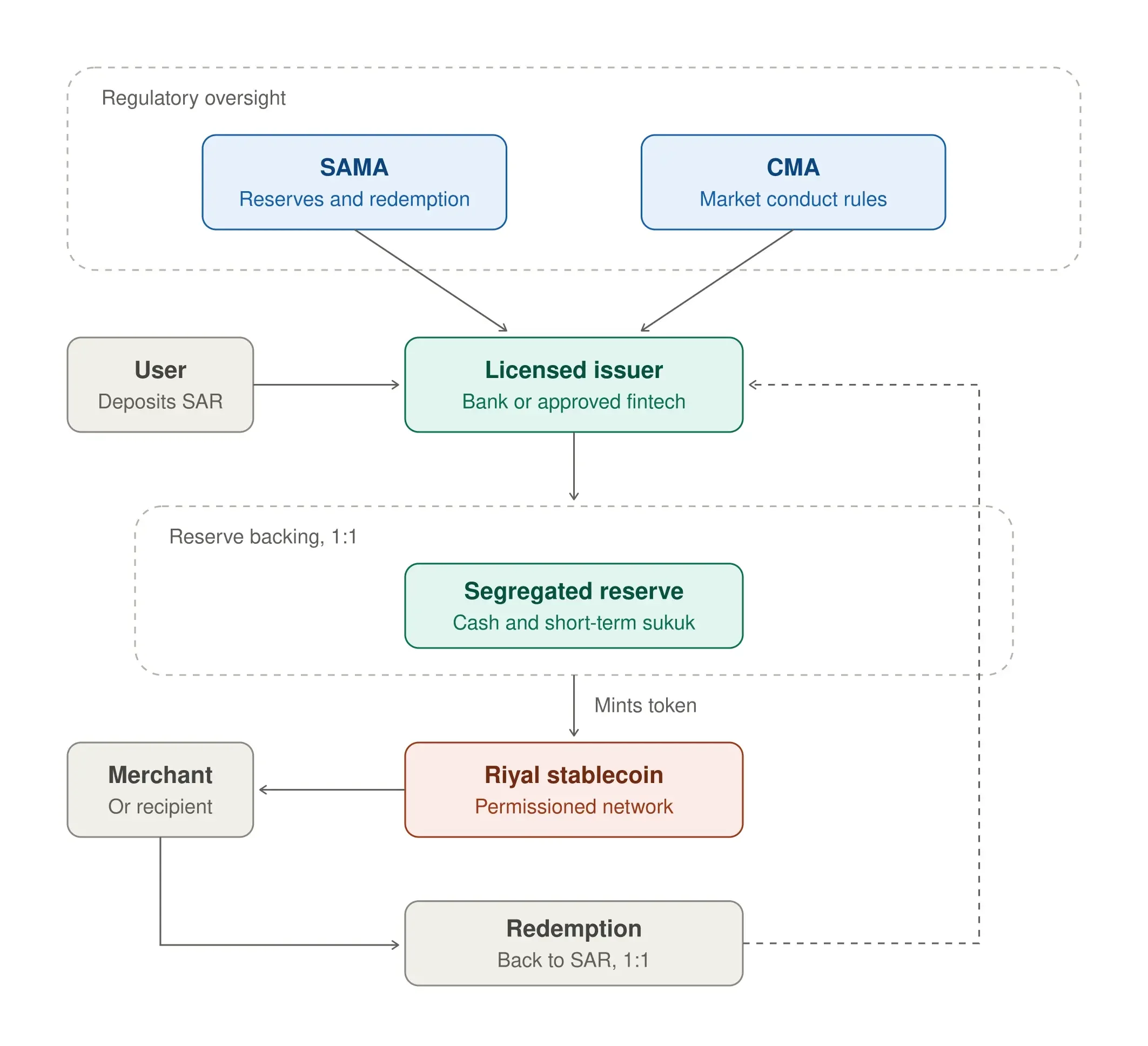
Created using Claude
The Takeaway
Stablecoins are now core financial infrastructure, and the market has already chosen its early winners in USDT and USDC. Saudi Arabia is building its own riyal-denominated settlement systems, on its own regulatory terms, drawing on what the UAE has already proven next door. If my read is right, the technology stack will follow mBridge's precedent: permissioned, EVM-compatible, and validated exclusively by SAMA and a short list of licensed banks.
The pieces are all on the table already: founding membership in mBridge, domestic wholesale CBDC testing, the announced joint SAMA and CMA mandate, a live Chainlink partnership at Saudi Awwal Bank, Jeel's memorandum with Ripple, and 85% of retail payments already electronic. What is left is sequencing, and on the region's track record that is very likely wholesale first, bank-led, Shariah-compliant, and retail-ready only once the foundation has been stress-tested.
The practical window is short. The regulation has not been published, which means anyone building today on a permissioned, EVM-compatible assumption reaches the first licence ready to operate rather than ready to start. If you are building in payments, tokenization, or banking services in the Kingdom, the right move now is to design your settlement layer to accept a single licensed issuer on a permissioned network, without needing to rewrite the foundation later.
A note on how this was produced: AI was used for initial research, drafting, and translation. I reviewed the full text and verified every figure, fact, and source before publishing. The analysis and predictions are my own.
References
Stablecoins 'new foundation for global value movement': Al-Hogail. (2025, October 27). Argaam. https://www.argaam.com/en/article/articledetail/id/1852947
Swift's blockchain ledger ready for use as 17 banks set to pioneer tokenised cross-border payments on trusted global infrastructure. (2026, July 9). Swift. https://www.swift.com/news-events/press-releases/swifts-blockchain-ledger-ready-use-17-banks-set-pioneer-tokenised-cross-border-payments-trusted-global-infrastructure
Global crypto exchanges back Saudi Arabia's stablecoin, digital asset ambitions. (2025, November 6). Al Arabiya English. https://english.alarabiya.net/News/saudi-arabia/2025/11/06/global-crypto-exchanges-back-saudi-arabia-s-stablecoin-digital-asset-ambitions
Saudi Arabia Moves to Integrate Stablecoins, Expand Real Estate Funds. (2025, October 27). Asharq Al-Awsat. https://english.aawsat.com/business/5201905-saudi-arabia-moves-integrate-stablecoins-expand-real-estate-funds
Project mBridge reaches minimum viable product stage and invites further international participation. (2024, June 5). Bank for International Settlements. https://www.bis.org/press/p240605.htm
Project mBridge: Updates and resources. Bank for International Settlements. https://www.bis.org/about/bisih/topics/cbdc/mcbdc_bridge.htm
Zand launches UAE's first AED-backed stablecoin on public blockchain. (2025, November 17). Zawya. https://www.zawya.com/en/press-release/government-news/zand-launches-uaes-first-aed-backed-stablecoin-on-public-blockchain-osc5inog
UAE accelerates digital finance with new AED stablecoin approval for DDSC on ADI Chain. (2026, February 12). Cryptonomist. https://en.cryptonomist.ch/2026/02/12/aed-stablecoin-uae-adi-chain/
Saudi Awwal Bank partners with Chainlink to leverage CCIP and CRE in blockchain innovation pact. (2025, September 17). Cryptopolitan. https://www.cryptopolitan.com/saudi-awwal-bank-partners-with-chainlink/
Ripple Expands in Middle East with Riyad Bank Partnership. (2026, January 26). MEXC News. https://www.mexc.com/news/561057
SAMA Joins mBridge Project. (2024, June 5). Saudi Press Agency. https://spa.gov.sa/en/N2117066
UAE, Saudi central banks issue report on joint digital currency, 'Aber' project. Gulf News. https://gulfnews.com/business/banking/uae-saudi-central-banks-issue-report-on--joint-digital-currency-aber-project-1.1606654298973
Saudi Arabia fast-tracks shift to cashless economy on back of fintech boom. (2025, May 9). Arab News. https://www.arabnews.com/node/2600095/business-economy
RAKBank Receives Approval to Launch UAE Dirham-Backed Stablecoin. (2026, January 7). Brave New Coin. https://bravenewcoin.com/insights/rakbank-receives-approval-to-launch-uae-dirham-backed-stablecoin
In-Depth Virtual Currency Regulation: United Arab Emirates. (2025, November 5). Charles Russell Speechlys. https://www.charlesrussellspeechlys.com/en/insights/expert-insights/dispute-resolution/2024/in-depth-virtual-currency-regulation-uae/
Stablecoin Market Crosses $320B as Tether USDT Dominance Falls 2.5% in 2026. (2026, April 16). Bitcoin News. https://news.bitcoin.com/stablecoin-market-crosses-320b-as-tether-usdt-dominance-falls-2-5-in-2026/
Circle's USDC outpaces Tether's USDT growth for second year running. (2026, January 6). CoinDesk. https://www.coindesk.com/markets/2026/01/06/circle-s-usdc-outpaces-growth-of-tether-s-usdt-for-second-year-running
How will the GENIUS Act work in the US and impact the world? (2025, July). World Economic Forum. https://www.weforum.org/stories/2025/07/stablecoin-regulation-genius-act/
The GENIUS Act: A Comprehensive Guide to US Stablecoin Regulation. Paul Hastings LLP. https://www.paulhastings.com/insights/crypto-policy-tracker/the-genius-act-a-comprehensive-guide-to-us-stablecoin-regulation
The GENIUS Act: A Framework for U.S. Stablecoin Issuance. (2025, July). Sidley Austin LLP. https://www.sidley.com/en/insights/newsupdates/2025/07/the-genius-act-a-framework-for-us-stablecoin-issuance
